
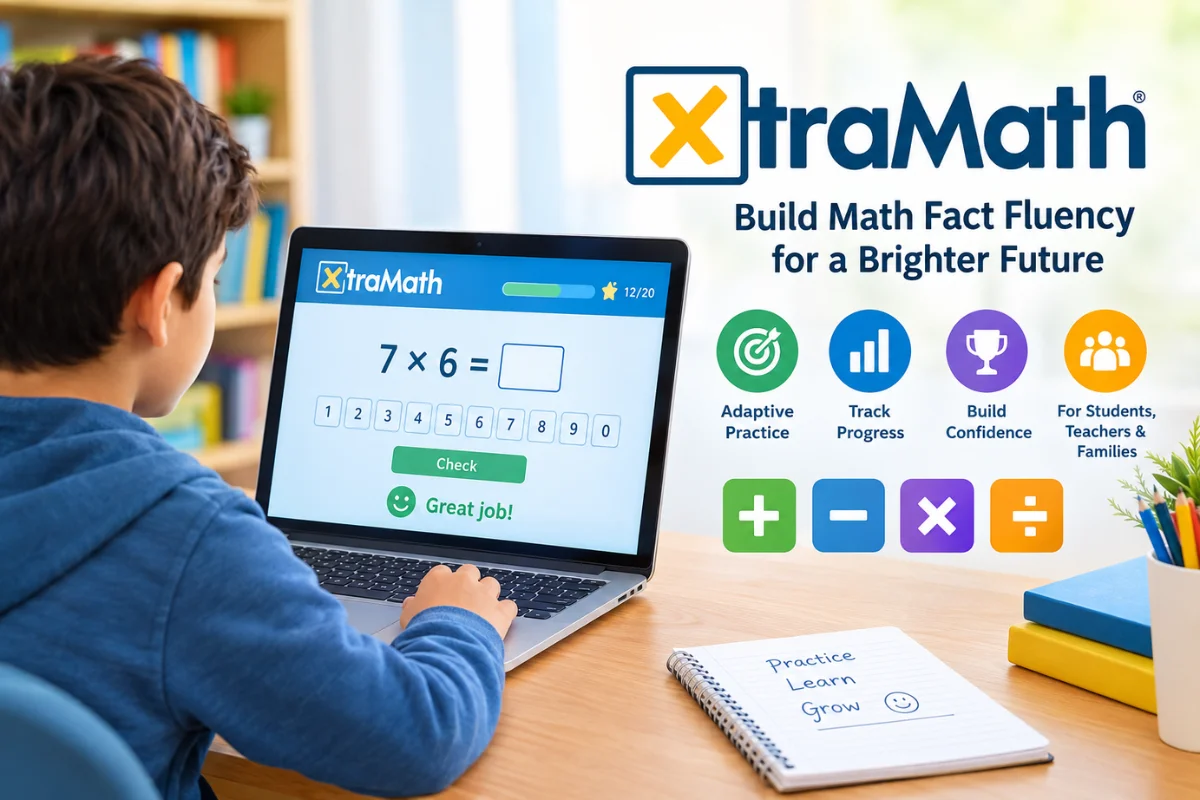
Learning math is not only about understanding formulas and solving complex problems. Students also need to become comfortable with basic arithmetic facts. When addition, subtraction, multiplication, and division facts become easier to recall, children can spend more attention on problem-solving and more advanced mathematical concepts.
This is where XtraMath can be useful. XtraMath is an online math fact fluency program designed to help students develop faster and more automatic recall through short, regular practice sessions.
Rather than trying to replace classroom mathematics instruction, XtraMath focuses on a specific part of learning: helping students remember basic math facts accurately and efficiently.
What Is XtraMath?
XtraMath is a nonprofit online learning program focused on basic math fact fluency. It is primarily designed for elementary students, particularly those in grades K–6, although older students can also use it for review, intervention, or additional practice.
The program covers four major arithmetic operations:
- Addition
- Subtraction
- Multiplication
- Division
XtraMath uses short practice sessions and an adaptive approach to give students opportunities to work on facts according to their current level of fluency. The system identifies facts that need more practice and reinforces them over time.
The main goal is not simply to make students complete more questions. Instead, the program aims to help students develop automatic recall so they can retrieve basic facts without having to work through every calculation from the beginning.
How Does XtraMath Work?
XtraMath follows a structured process that combines assessment, practice, and progress tracking.
When students begin using the program, they may complete a placement assessment to establish a starting point. This gives teachers and parents a baseline for understanding the student’s existing fluency.
After that, students participate in short daily sessions. A typical session lasts around 10 minutes and includes a progress quiz followed by practice activities.
The system adapts practice according to the student’s performance. Facts that are already familiar require less attention, while facts that are still developing can appear more frequently.
This approach is similar to spaced repetition. Instead of presenting every fact with the same frequency, XtraMath adjusts practice so students can continue strengthening areas where recall is not yet automatic.
Why Math Fact Fluency Matters
Basic arithmetic facts may appear simple, but they form an important foundation for more advanced mathematics.
For example, a student working on fractions may need to multiply or divide numbers while also thinking about the larger problem. If basic calculations require significant mental effort, some of the student’s attention is taken away from understanding the actual concept.
Strong fact fluency can reduce that extra mental load.
Students who can quickly recall basic facts may find it easier to work with fractions, algebraic expressions, multi-step problems, and other mathematical tasks. XtraMath therefore concentrates on a foundational skill rather than attempting to teach every area of mathematics.
What Students Do During an XtraMath Session
The student experience is designed around short and focused practice.
A typical session begins with a progress quiz. This helps measure improvement and retention over time. Students then move into practice activities that focus on strengthening their recall of particular facts.
The program can adjust the difficulty and practice settings based on the student’s needs.
Teachers can select operations, difficulty levels, and time thresholds. Available threshold options include 12, 6, 3, 2, and 1.5 seconds, allowing educators to adjust the experience for different learners.
This flexibility can be particularly useful because students do not all develop fluency at exactly the same speed.
XtraMath Features at a Glance
| Feature | How It Helps |
| Daily practice | Gives students regular opportunities to strengthen math facts |
| Adaptive practice | Adjusts practice based on individual performance |
| Progress quizzes | Helps measure changes in fluency over time |
| Fluency scores | Provides a snapshot of performance in an operation |
| Teacher reports | Allows educators to monitor individual and class progress |
| Parent access | Helps families follow a child’s progress |
| Adjustable thresholds | Gives teachers control over response-time expectations |
| Multiple operations | Supports addition, subtraction, multiplication, and division |
| Certificates and awards | Provides recognition for learning milestones |
| Free core program | Makes basic practice accessible without a paid subscription |
Understanding the XtraMath Fluency Score
One of the most useful parts of XtraMath is its fluency score.
The score represents a student’s progress in a particular operation. It is based on recent quiz performance rather than functioning as a traditional school grade.
A score of 100 represents complete mastery of the specific operation within the program. Students can then move toward another operation or work with a lower fluency threshold.
It is important for parents and teachers to understand that a fluency score can naturally move up and down. A temporary decrease does not necessarily mean that a student has lost all of their knowledge.
XtraMath itself recommends viewing the score as an indicator of progress rather than as a classroom grade.
Is XtraMath a Math Teaching Program?
There is an important distinction to understand.
XtraMath is primarily a fluency tool, not a complete mathematics teaching curriculum. It is designed to strengthen recall of facts that students already understand.
For example, if a child does not yet understand what multiplication means, repeatedly answering multiplication questions under time pressure may not provide the conceptual instruction that child needs.
Teachers should first make sure students understand the mathematical concepts and can solve problems accurately without time pressure. XtraMath can then be used to help turn those understood facts into faster and more automatic recall.
This makes XtraMath most effective when it is used alongside classroom instruction rather than as a replacement for it.
Benefits for Teachers
XtraMath gives teachers several tools for monitoring student progress.
Teachers can organize students into classes, assign programs, adjust settings, and review reports. The platform provides different reports that can help educators examine progress at both the class and individual-student level.
Teachers can also customize practice according to individual needs. For example, one student may need additional multiplication practice while another may still be developing subtraction fluency.
This level of customization can make short practice sessions more targeted.
XtraMath also supports classroom recognition through awards and certificates. These features give teachers a simple way to recognize milestones without turning every practice session into a competition.
Benefits for Parents and Families
Parents can also use XtraMath to stay informed about a child’s progress.
Teachers can send family flyers that connect a student with a parent or guardian account. Linked family members can view progress and retrieve student PIN information when necessary. XtraMath also provides options for keeping families informed through progress reports.
This can make home practice easier because parents do not necessarily need to create an entirely separate learning system.
A short daily routine can be enough to give children regular opportunities to practice their arithmetic facts.
Is XtraMath Free?
The core XtraMath program is available for free. According to XtraMath, the free version provides students with daily math fact fluency practice.
Additional paid licensing options are available for families, teachers, and schools that need expanded features such as customization, advanced reporting, classroom resources, or additional administrative tools.
This structure allows families and educators to begin with the basic program before deciding whether additional features are necessary.
Because pricing and plan features can change, users should check the official XtraMath pricing information when making a purchasing decision.
XtraMath and Student Progress Tracking
Progress tracking is one of the platform’s central functions.
The fluency matrix provides a more detailed view of individual math facts, while reports allow adults to look at broader progress. Teachers can use this information to identify students who may need additional instruction or practice.
The system can therefore provide more information than simply showing whether an answer was correct or incorrect.
However, progress data should be interpreted alongside classroom performance. A student’s ability to solve a real-world math problem involves more than the speed with which they recall an arithmetic fact.
Who Can Benefit From XtraMath?
XtraMath is primarily intended for elementary-age learners, but its use does not have to stop there.
It can also be useful for older students who need to review foundational arithmetic skills. Students receiving additional intervention may benefit from focused practice, while students who already understand their arithmetic concepts can use the program to improve automatic recall.
The most important factor is whether the student needs additional practice with basic facts.
Students who are still struggling to understand the underlying mathematical concepts may need direct instruction, visual models, manipulatives, or other teaching strategies before fluency practice becomes effective.
Getting Started With XtraMath
Getting started generally involves creating an appropriate teacher, family, or school account and setting up students.
Student accounts are created or managed by an authorized adult rather than by young students independently. XtraMath also supports sign-in options and integrations designed to make classroom management easier for educators.
Once a student is enrolled, the educator or parent can select an appropriate program and allow the student to begin practicing.
For the best experience, students should use a modern internet-connected device with JavaScript enabled. Headphones may also be useful in shared environments because the program includes instructional videos.
Tips for Using XtraMath Effectively
The biggest benefit of XtraMath usually comes from consistency rather than very long practice sessions.
A few simple habits can make the experience more productive:
Keep Sessions Short
The program is designed around short sessions. There is usually no need to make a child spend a long period repeatedly practicing arithmetic facts.
Focus on Accuracy First
Students should understand the mathematics before being expected to recall facts quickly. Speed should develop after accuracy and understanding.
Avoid Treating the Score Like a Grade
A fluency score is a progress indicator, not a replacement for classroom assessment.
Adjust the Time Setting When Necessary
Some learners may need more time, while others may be ready for a shorter threshold. Teachers can adjust the setting according to student needs.
Celebrate Progress
Recognition can help students remain motivated. Small milestones, certificates, and positive feedback can make repetitive practice feel more meaningful.
Final Thoughts
XtraMath provides a focused approach to one important part of mathematics: basic fact fluency. Its short sessions, adaptive practice, progress tracking, and customizable settings make it possible to give students regular opportunities to strengthen arithmetic recall.
The platform works best when it complements good mathematics instruction. It does not replace lessons that explain mathematical concepts, strategies, or problem-solving.
For students who already understand basic operations but need more practice turning that knowledge into automatic recall, XtraMath can provide a structured daily routine. Its free core program also makes it accessible to families and classrooms looking for a straightforward way to practice essential math facts.
