
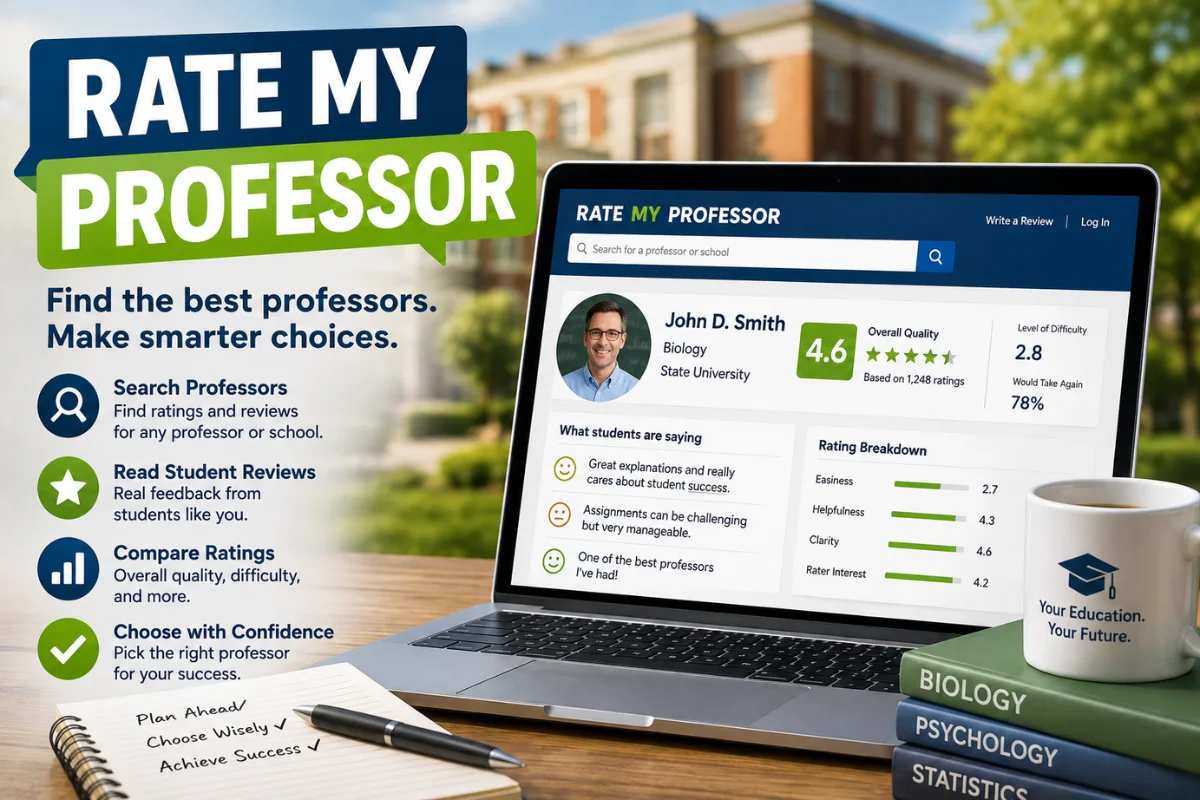
Choosing a college professor can have a major impact on a student’s classroom experience. The same subject can feel completely different depending on the instructor’s teaching style, grading methods, workload, and approach to students. This is one reason platforms such as Rate My Professors continue to attract attention from college students.
Rate My Professors is an online platform where students can research professors and read feedback about their classroom experiences. The official site describes itself as a destination for students researching and rating professors, colleges, and universities across the United States.
Students commonly use the platform before registering for a class. They may want to know whether a professor explains concepts clearly, assigns heavy workloads, grades fairly, or creates a supportive classroom environment.
However, ratings are only one source of information. Because reviews are submitted by individual students, they can reflect personal experiences rather than a complete picture of a professor’s teaching ability.
What Is Rate My Professor?
Rate My Professor is commonly used by students who want to research an instructor before choosing a course. Users can search for professors by name and school and then review available ratings and comments.
The platform allows students to share feedback about professors and courses. According to its official guidelines, ratings should come from students who have taken or are currently taking a class with the professor.
The basic idea is simple. Students share their experiences, and other students use those experiences as additional information when making academic decisions.
The website can be particularly useful during course registration periods, when students are comparing several sections of the same subject.
How Rate My Professors Works
Using Rate My Professors generally starts with searching for a school or professor. Once a professor’s profile is found, students can review available ratings and comments.
The platform provides several pieces of information that can help students understand what a class may be like.
One important rating is Overall Quality. The official help center explains that scores from 3.5 to 5 are considered good, 2.5 to 3.4 are average, and 1 to 2.4 are poor.
Another separate measurement is Level of Difficulty, which uses a scale from 1 to 5. A lower score indicates an easier experience, while a higher score indicates greater difficulty.
Students may also see information about whether previous reviewers would take the professor again.
Understanding Rate My Professors Ratings
A rating should not be viewed as a simple score that determines whether a professor is good or bad.
For example, a professor with a high difficulty score might still receive excellent overall ratings because students appreciate the quality of instruction. On the other hand, a professor with an easy class may not necessarily provide the strongest learning experience.
The official rating system separates overall quality from difficulty. This distinction is important because students often have different priorities when selecting a course.
A student preparing for a challenging major course may value teaching quality more than an easy workload. Another student balancing several difficult classes might pay more attention to workload and course difficulty.
Common Rating Factors
| Rating Factor | What It Can Tell Students |
| Overall Quality | General student perception of teaching |
| Level of Difficulty | How challenging the course may feel |
| Would Take Again | Whether reviewers would choose the professor again |
| Textbook Use | Whether the recommended textbook was used |
| Written Reviews | Personal experiences and classroom details |
These factors work best when considered together rather than separately.
Why Students Use Rate My Professor
The biggest advantage of Rate My Professor is convenience. Students can quickly find opinions from people who have previously taken a class.
A course description may tell students what topics will be covered, but it usually does not explain how an instructor communicates, how much homework is assigned, or what students found particularly challenging.
Reviews can provide additional context.
For example, several students might mention that a professor gives detailed feedback, holds regular office hours, or expects students to participate in class. Those details can help a prospective student understand the classroom environment before enrolling.
Recent student publications continue to show that Rate My Professors remains part of the course-selection conversation in 2026. At the same time, students and faculty continue to debate how much weight should be given to online ratings.
How to Read Reviews More Carefully
Not every review should be treated as equally reliable.
A single very positive or very negative comment may represent one student’s experience. It does not necessarily describe how every student experiences the course.
Instead of focusing on one review, look for repeated patterns.
If multiple students independently mention that an instructor explains difficult concepts clearly, that pattern may be more useful than one short comment saying the professor is excellent.
The same approach applies to negative feedback. If several students mention the same issue, it may deserve attention. If one reviewer complains about something that nobody else mentions, it may simply reflect an individual preference.
Look for Detailed Reviews
Detailed reviews are generally more useful than reviews containing only a score.
A comment explaining the workload, teaching style, exams, attendance requirements, or grading approach gives students something they can actually evaluate.
For example, “hard class” provides limited information. A review explaining that the professor gives weekly assignments, two major exams, and frequent participation grades provides much more useful context.
Students should therefore look for specific information rather than relying entirely on numerical ratings.
Rate My Professor and Anonymous Reviews
Anonymity is an important part of the platform. It allows students to share their experiences without publicly attaching their names to their comments.
At the same time, the platform acknowledges that it cannot completely verify the identity, truthfulness, or enrollment status of every contributor. Users are required to certify that they are students who took the relevant course, while moderation is used to identify suspicious or inappropriate contributions.
This means anonymity can be useful, but it also creates a reason for students to evaluate reviews carefully.
How Rate My Professors Handles Moderation
Rate My Professors has guidelines governing what users can post.
The platform says its moderators read submitted ratings and remove comments that do not comply with its guidelines. Users can also flag a comment for review if they believe it violates the rules.
The guidelines also encourage students to focus on their actual learning experiences.
Reviews should not focus on personal characteristics such as a professor’s appearance, age, gender, or race. The platform also discourages hearsay and asks reviewers to provide honest, constructive feedback.
This approach is designed to make reviews more useful for students researching courses.
Can Professors Have a Rate My Professors Account?
Professors can create accounts to engage with their profiles and receive updates about new ratings.
The platform’s help center says professors can register using a school-issued .edu email address. Creating an account is different from adding a professor profile to the site.
This can give instructors a way to stay aware of feedback connected to their profiles.
However, the existence of a professor account does not mean students should expect every review to be changed or removed simply because it is negative. Rate My Professors states that moderators do not remove a rating merely because it has a low score or expresses a negative opinion.
Is Rate My Professor Accurate?
The answer depends on how the information is used.
Rate My Professors can provide useful firsthand perspectives, but it should not be treated as an official evaluation of a professor’s teaching performance.
A recent 2026 discussion involving faculty at NC State highlighted concerns that voluntary reviews can overrepresent strong positive or negative experiences. Faculty interviewed for the report recommended that students also speak directly with professors and students who have taken the course.
That does not make the platform useless. Instead, it means students should use it as one part of a broader research process.
Benefits of Using Rate My Professors
There are several reasons students continue to use the platform.
Quick Access to Student Experiences
Students can quickly see what previous classmates have said about a professor.
Course Planning
Ratings can help students compare instructors when multiple sections of the same course are available.
Insight Into Teaching Style
Written comments may reveal information that is not included in official course descriptions.
Workload Awareness
Difficulty ratings and detailed comments can provide clues about assignments, exams, and overall workload.
Discovering Patterns
When many reviews describe similar experiences, students may identify useful patterns before registering.
Limitations Students Should Consider
The platform also has limitations.
First, reviews are voluntary. Students who choose to post may have stronger opinions than students who simply completed a class and moved on.
Second, different students have different expectations. A student who wants a relaxed class may dislike an instructor who assigns frequent work, while another student may appreciate the structure.
Third, professors can teach differently across semesters, course levels, and subjects. A review from several years ago may not perfectly represent the current classroom experience.
Finally, online ratings cannot replace official university information about course requirements, prerequisites, schedules, or academic policies.
How to Use Rate My Professor Effectively
The best approach is to combine several sources.
Start by checking the professor’s overall rating. Then look at the difficulty score and the percentage of students who would take the instructor again.
After that, read several recent written reviews.
Pay attention to repeated comments about teaching style, workload, exams, attendance, communication, and grading.
Next, compare the information with the official course description and syllabus if available.
You can also ask classmates or students who have previously taken the course. This can provide a more balanced perspective than relying on an online rating alone.
Should You Trust Rate My Professor?
Students should use it, but not depend on it.
A well-written review can reveal practical information that may be difficult to find elsewhere. However, a numerical score cannot capture every aspect of a professor’s teaching.
The best decision comes from combining student feedback with official academic information and, when possible, direct conversations with students or instructors.
This balanced approach can help students avoid choosing a course based on one unusually positive or negative comment.
Final Thoughts
Rate My Professor remains a popular resource for students researching instructors and planning college courses. Its combination of numerical ratings, difficulty scores, written comments, and student feedback can provide useful insight before registration.
However, online reviews are personal experiences rather than universal facts. A professor who receives mixed ratings may be an excellent choice for one student and a poor fit for another.
The smartest way to use the platform is to look for patterns, read detailed reviews, consider recent feedback, and compare what you find with official course information.
Ultimately, Rate My Professor works best as a starting point for research rather than the final authority on which professor or course a student should choose.
